Are you on septic or city sewer?
Many homes in the Columbia area are on city sewer, but plenty of rural and lakeside properties in Lexington and Richland counties use septic tanks. If you are not sure, check your bill. A monthly sewer charge points to a public system, and the absence of one suggests a tank in the yard.
The answer matters because a septic system is a small treatment plant, and what you put down the drain shapes how it performs. A disposal sends a steady stream of food solids into that system.
How a septic system works
Wastewater flows into a buried tank, where solids settle to the bottom as sludge and grease floats as scum. Clearer water in the middle drains to a field where soil treats it. Bacteria in the tank break down some of the solids, but not all of them.
When sludge and scum build too high, solids can reach the drain field and clog it. A clogged field is expensive to repair, which is why people on septic pay attention to what goes in.
Disposal jammed or leaking?
Switch off the power and call. Do not reach into the unit.
What a disposal changes
Ground food scraps are still solids, and they add to the tank. Here is how that plays out.
| Effect | Without a disposal | With a disposal |
|---|---|---|
| Solids entering the tank | Lower | Higher, finely ground food adds to sludge |
| Pumping frequency | Standard schedule | Often more frequent |
| Grease and fats | Sink habits matter | Grinding does not remove grease |
| Bacterial balance | Steady | Heavy loads can strain it |
| Risk of drain field clogging | Lower | Higher if the tank is not pumped on time |
What to keep out of the disposal on septic
If you keep a disposal, treat it as an occasional tool, not a trash can.
- Grease, oil and fat. They float as scum and coat the pipes and field.
- Coffee grounds and eggshells in quantity. They add dense solids.
- Fibrous scraps. Celery, corn husks and onion skins tangle and settle.
- Starches in bulk. Rice, pasta and potato peels swell and pack.
- Harsh chemicals. Strong cleaners and bleach in large amounts can harm the bacteria.
Pumping schedules
The Environmental Protection Agency suggests that households inspect their septic systems about every three years and pump them every three to five years, depending on size and use. A household with a disposal, a large family or a small tank may need to pump more often. A septic professional can measure sludge and scum and recommend a schedule.
Plumbers handle the pipes and the disposal. A septic contractor handles the tank, the field and the pumping, and we are upfront about that line.
Signs the system is struggling
Septic trouble usually announces itself. These are the signs to watch.
Slow drains throughout the house
Several fixtures draining slowly can mean a full tank or a clogged field.
Gurgling pipes
Air pushed back through the lines suggests a blockage.
Wet or spongy ground over the field
Untreated water is rising to the surface.
Sewage odor near the tank
The tank or its lid may be failing.
Septic or sewer: more ways to tell
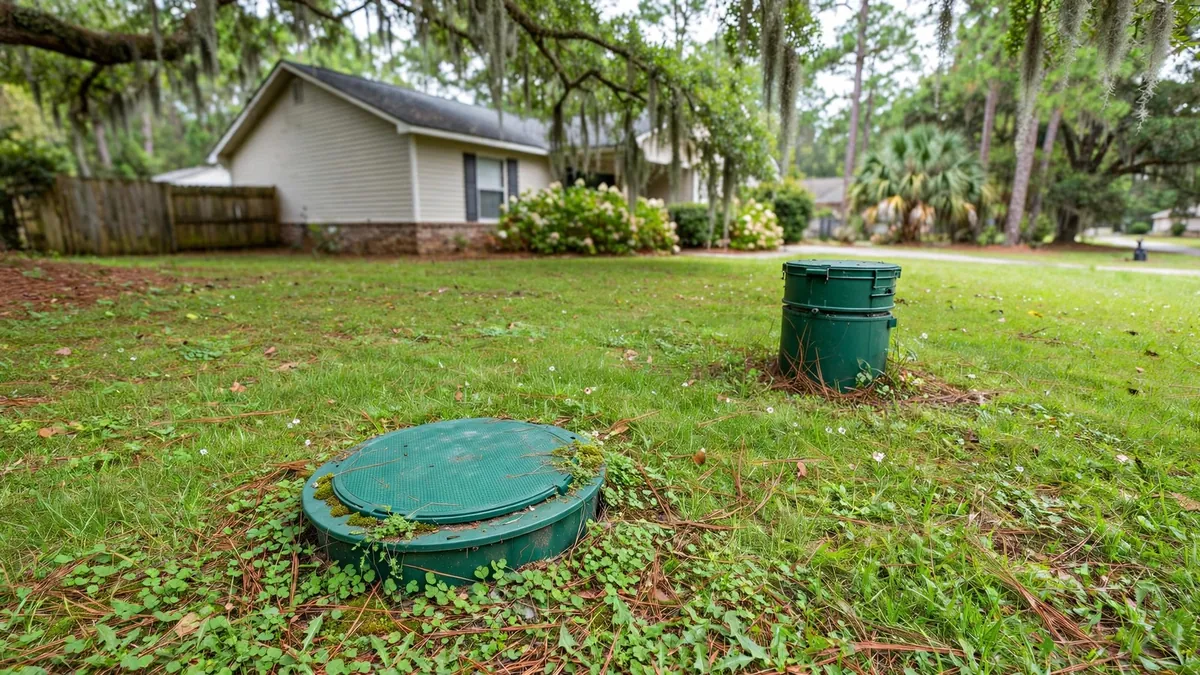
A property tax or utility record may list your sewer service. Your city or county health office keeps permit records for septic systems. A visible lid or a riser in the yard, usually a round or square cover, suggests a tank. Water usage records alone do not tell you, but a missing sewer charge on your bill does.
If you bought the house recently, your closing papers or home inspection may include a septic inspection. If you cannot find a record, a septic contractor can locate the tank with a probe.
What a pumper checks
A septic visit is more than emptying the tank.
| Part | What is checked | Why it matters |
|---|---|---|
| Sludge and scum layers | Thickness | Tells you when to pump |
| Baffles | Condition and position | Keep solids from the field |
| Effluent filter | Cleaned or replaced | Catches particles |
| Lid and risers | Secure and intact | Safety and access |
| Drain field | Any soggy or lush areas | Early sign of failure |
Protect the drain field
The field is the costly part, so treat it with care.
- Keep vehicles off it. Weight compacts soil and crushes pipes.
- Plant grass, not trees. Roots seek water and enter lines.
- Spread out laundry. Many loads in one day can overwhelm the system.
- Fix leaks. A running toilet adds water all day.
- Divert roof drains away. Extra water can saturate the field.
Septic tank safety: what to do and what never to do
A septic tank is a confined space with hazardous gas. Treat it with respect.
- Never climb into a tank. Hydrogen sulfide and methane can overcome a person in seconds, and many deaths happen to would-be rescuers.
- Keep lids secure. A missing or cracked lid is a fall hazard for children and pets.
- Do not use a lighter or flame near an open tank. Methane is flammable.
- Leave pumping and repairs to professionals. They have gas monitors and the right equipment.
- Call for help at the first sign of failure. Standing sewage on the ground should be avoided until it is addressed.
Alternatives to grinding
On a septic system, the simplest option is to scrape plates into the trash or a compost bin and skip the disposal. Compost keeps food waste out of the tank, and it makes useful soil for a garden. A sink strainer catches the rest.
If you love your disposal and have city sewer, nothing here applies. If you are on septic and keep one, grind small amounts with cold water running, and keep a closer eye on the pumping schedule.
How common septic is
The Environmental Protection Agency reports that about one in five American households uses a septic system, and the share is higher in rural parts of the country. EPA guidance suggests an inspection at least every three years and pumping every three to five years, which a heavy disposal user should treat as the short end of that range.
If you are replacing a disposal
If a disposal needs replacing on a septic home, consider whether you really want to keep it. A strainer and a compost bin cost less than a premature pump-out. If you keep one, choose a model with a good motor and use it lightly. Our page on garbage disposal repair and installation covers the installation details. For a kitchen line that clogs repeatedly, drain cleaning is the first step.
Properties near Lexington and around Lake Murray are where this question comes up most often.
Disposal and septic questions
Many people do, but it increases solids and may require more frequent pumping. Use it sparingly.
EPA guidance suggests every three to five years. Your size and usage may change that.
Their benefits are debated. A regular pumping schedule matters more.
Slow drains throughout the house, gurgling, odors near the tank and soggy ground over the field are common signs. The reliable method is a professional inspection that measures the sludge and scum layers.
Small amounts are tolerated, but both add dense solids that settle in the tank. Composting them or putting them in the trash is easier on the system.