Emergency Drain Cleaning in Columbia, SC
Gurgling toilets, a tub that fills when the washer drains and sewage at a floor drain show how deep a blockage sits, and the cleaning method follows from that.
- 24/7 emergency calls
- Sinks to main lines
- Camera when it keeps returning
Which drain is blocked? Read the symptoms
Where the water shows up tells you how deep the clog sits. It also decides how urgent the call is.
| What you see | Where the clog probably is | How urgent |
|---|---|---|
| One slow sink or tub | That fixture's own trap or branch line | Can wait for the next appointment |
| Several fixtures in one bathroom | The branch line serving that room | Call within the day |
| Toilets gurgle, tub backs up when the washer drains | The main line | Emergency, stop using water |
| Sewage in a floor drain or the lowest tub | The main line or the sewer lateral | Emergency, stop using water |
Cable, jet or camera: how a technician chooses
A cable clears a soft clog such as hair and paper. It punches a hole through a blockage, which is why grease and roots often return a few weeks later. Hydro jetting scours the pipe wall with high-pressure water and handles grease and root growth better.
When a drain clogs a second time, a camera is the honest next step. It shows whether the cause is a belly in the pipe, a broken joint or roots, and it turns a guess into a repair plan.
Water coming up where it should go down?
Stop running water and call. The first answer is which line is blocked.
What should never go down the drain
Most clogs we see have a cause that is easy to avoid once you know it.
- Cooking grease. It cools and coats the pipe wall. Pour it into a can, not the sink.
- Wipes labeled flushable. They do not break down like paper and are a leading cause of main line clogs.
- Coffee grounds and rice. They pack into traps and slow the flow.
- Paper towels and feminine products. They are built to hold together when wet.
- Harsh drain openers. Caustic chemicals can damage old pipe and are dangerous for the person who opens the line next.
Old lines, big lots and tree roots in the Columbia area
Mid-century neighborhoods like Forest Acres have long laterals on large lots with mature trees, and roots find joints in clay and cast iron. In the older mill-village blocks of West Columbia, branch lines may be a century old.
If roots are the cause, cleaning is a temporary fix and a repair is the permanent one. Our page on sewer line repair explains the options once a camera confirms the damage.
Backups after heavy rain
In October 2015 one gauge on Gills Creek logged 10.64 inches of rain in four hours. Saturated ground and overloaded public sewers can push water back into low fixtures, and a drain that gurgles only during storms points to a sewer that cannot keep up.
A backwater valve on the lateral is the permanent protection for a low-lying lot. Until it is installed, avoid running water during storms and call if sewage appears.
What a drain cleaning visit looks like
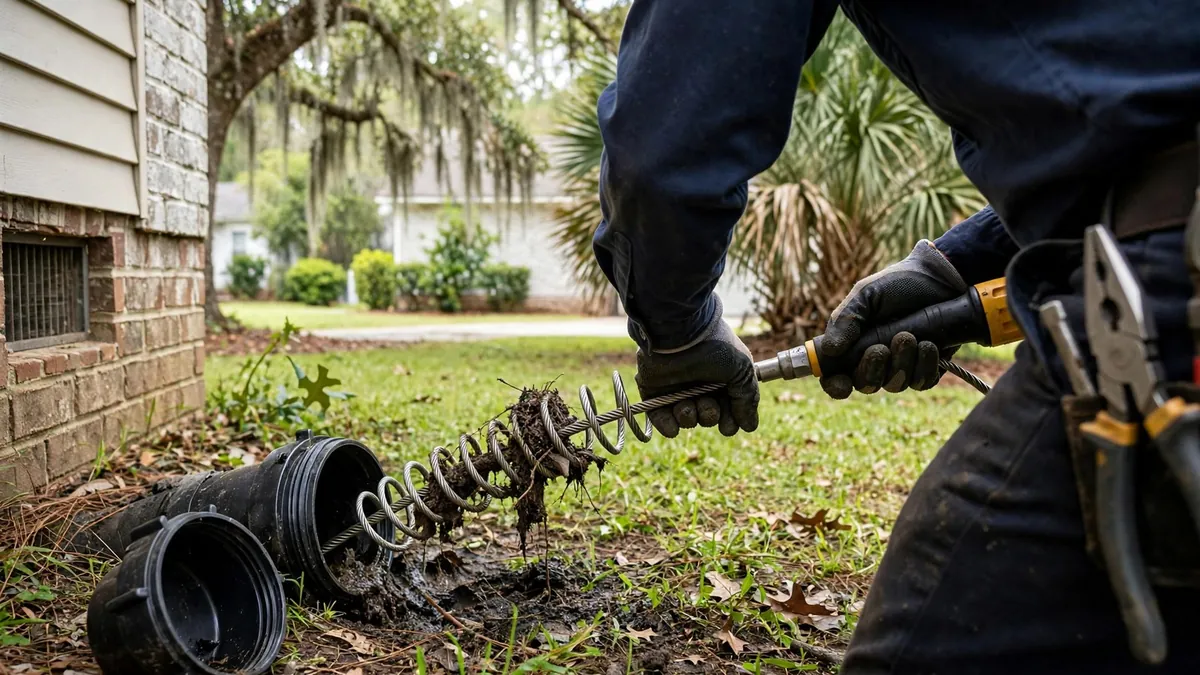
The technician asks which fixtures are affected, finds the nearest cleanout and chooses a method. For a sink, that is usually a hand cable through the trap. For a main line, it is a powered cable or a jet run from the cleanout, often with a camera pass afterward to confirm the line is clear.
You should leave with a clear explanation of the cause, what was removed and what to watch for. The International Plumbing Code (IPC) calls for accessible cleanouts on building drains, so a missing cleanout is a defect and not just an inconvenience. A drain that clears once but returns is a symptom, not a fix.
Know where your cleanout is
A cleanout is a capped pipe that gives direct access to the main line, often near the foundation, in a crawlspace or outside near the house. Finding it before an emergency saves time and money. Without one, a technician may have to pull a toilet to reach the line.
Mark the cap with a flag or a photo on your phone. If your house has no cleanout, adding one is a small project that pays for itself the next time the line backs up.
Keeping drains flowing between visits
Flush kitchen drains with hot water after washing greasy dishes and use a strainer in tubs and showers. Run cold water when using a disposal, and put grease in the trash. Twice a year, run a long cleaning pass in any line that has clogged before.
If the same drain clogs more than twice in a year, ask for a camera look, because a repeat clog is a pipe problem.
What to do when sewage backs up: safety steps
Sewage carries bacteria, so the first steps protect people before they protect floors.
- Stop using water. Do not flush, run the washer or use the dishwasher, because everything you send down comes back up.
- Keep people and pets out. Close off the room and keep children and animals away from the affected area.
- Avoid contact. Do not wade through it barefoot or handle soaked items without gloves and boots.
- Never mix cleaning chemicals. Combining bleach with other cleaners can release dangerous fumes.
- Photograph the damage, then call. Photos help your insurer, and a camera inspection finds the blockage.
Odors from drains: traps, vents and dry floor drains
A sewer smell in a bathroom often comes from a dry trap. A seldom-used tub or floor drain loses its water seal, and gas rises through the drain. Running water for a minute usually restores the seal. If the smell returns, a blocked plumbing vent or a failing wax ring may be the cause.
Gurgling toilets together with an odor suggest a vent or main-line problem. A camera and a vent check will separate the two.
Rental and multi-unit properties
In a shared building, one tenant's slow drain can be the first sign of a main line problem that affects everyone downstream. Landlords should document each call, note which units are affected, and schedule a camera look when two or more units report the same issue. That records the cause for insurance and for anyone who disputes responsibility.
Sewer service across the river and the county line
Columbia Water collects wastewater inside the city, while Cayce runs its own regional plant, which opened in October 2012. Which utility owns the main under your street decides who answers a street-side backup. Low ground near the Congaree Riverwalk in Lexington County and along Gills Creek in Richland County is where flood history makes sewer backups a bigger concern.
Pipe sizes decide the tool
A kitchen sink branch is usually 1.5 to 2 inches across, a bathroom branch is about 2 inches, and a main drain is typically 3 or 4 inches. A small cable fits a sink line, while a main line takes a longer, heavier cable or a jetting hose, which is why the clog's location sets both the method and the price.
What we ask before a technician heads out
Tell dispatch which fixture is slow or blocked and whether others are affected. One blocked sink is a branch problem, while a tub that fills when the washer drains points to the main line. A floor drain that bubbles in a storm is a different story from a toilet that gurgles.
Say whether the clog has come back before and how long ago it was last cleared. Those answers decide whether a cable is enough or whether a camera comes along on the first visit.
Clogs in the old streetcar suburbs
Shandon, Earlewood and Elmwood Park were laid out between about 1890 and 1910, and Elmwood Park was annexed in 1907 as the city's first suburb. Clay and cast iron laterals from that era collect roots and scale, so a main line clog there is more often a pipe problem than a one-time blockage.
A cable clears the stoppage, and a camera run afterward shows whether the pipe is cracked or offset. Repeated clogs in these neighborhoods usually justify the camera on the first visit.
What changes the price of drain cleaning
Drain work is priced by access, depth and method.
Insurance rarely pays to clear a clog. Sewage damage from a backup may be covered only with a sewer backup endorsement.
Want your real number? Call (844) 981-1691 and mention fixture or main line and cleanout access.
When a clog turns out to be something bigger
If water has soaked flooring, ask about water damage restoration. A toilet that keeps clogging may be a toilet problem and not a drain problem.
Drain cleaning questions
We advise against it. Chemicals can harm old pipe and are dangerous if the line is later opened by hand.
A cable leaves grease or roots on the pipe wall. A camera and a jetting pass usually solve it, or a damaged section needs repair.
If several fixtures gurgle or a tub backs up, yes. It points to the main line.
Yes. Kitchen lines clog with grease and food, and we clear them by cable or jet.