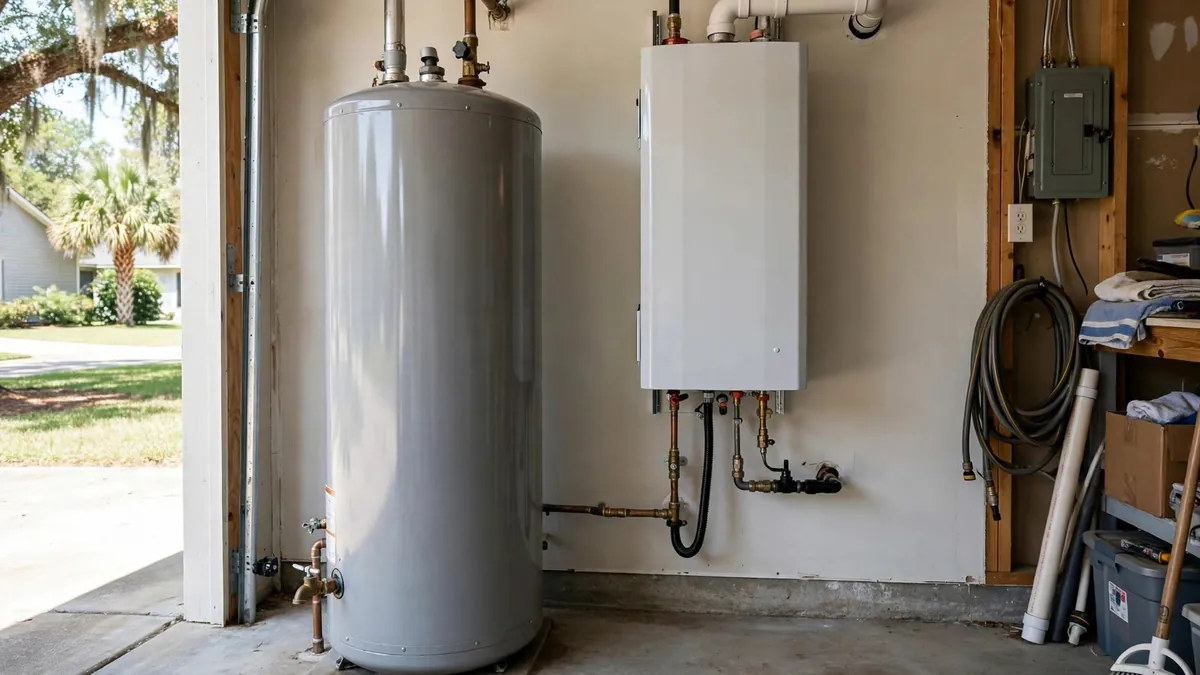
The basic difference
A tank heater keeps a reservoir of hot water ready, so it works from a modest gas line or a simple electric circuit. A tankless heater heats water as you use it, which means it needs a lot of energy at the moment you open the tap. That one fact explains most of the differences in cost and installation.
Neither type is better for every house. The choice depends on household size, the space available, the fuel supply and how you use hot water.
Side by side
This comparison reflects typical residential units. Models vary.
| Factor | Tank | Tankless |
|---|---|---|
| Upfront cost | Lower | Higher, with installation changes |
| Hot water supply | Limited by tank size | Continuous, limited by flow rate |
| Space | Floor space for a tall tank | Wall-mounted, compact |
| Typical life | About 8 to 12 years | Often 15 to 20 years with maintenance |
| Maintenance | Occasional flush, anode check | Yearly flush, filter and vent checks |
| Installation needs | Standard gas or 240-volt supply | Often a larger gas line and special venting |
Comparing quotes for a new heater?
Call with the quotes and we will help you compare what is included.
The gas line question
Gas tankless units draw far more fuel than a tank. A house with a half-inch line sized for a tank, a range and a dryer may not have enough capacity, and the unit starves under load. The symptom is a heater that fires and then shuts off when two fixtures run at once.
A good installer compares the line size to the unit's rating and follows the International Fuel Gas Code (IFGC) as South Carolina adopts it. Our page on gas line installation and repair explains the work, and our page on tankless water heater service covers maintenance.
Soft city water changes the maintenance story
Columbia Water reports about 1 to 2 grains per gallon, which is soft. Scale builds more slowly in a heat exchanger in that water than in a hard-water market, so descaling intervals can be longer than the national averages suggest. Follow the manufacturer's schedule to keep the warranty valid.
A private well or another utility's water can be much harder. Test it before you assume the same schedule applies.
Who benefits most from tankless
Households with high hot-water demand spread across the day tend to like tankless. Smaller homes with limited space and owners who plan to stay for years often see the payoff. Newer houses in places like Lexington often have a gas stub that can be upgraded.
Households that want the lowest purchase price, or have an electric supply and a small hot-water load, often do better with a tank.
A decision checklist
Answer these before you choose.
- What fuel do you have? Gas tankless needs a large line. Electric tankless needs heavy wiring.
- How many fixtures run at once? A flow-rate estimate tells you the unit size.
- How long will you stay? A longer horizon favors tankless.
- Where does the unit go? Venting and clearance limit options.
- What does the quote include? Gas line, venting, permit and haul-away should be itemized.
Thinking about cost over the life of the unit
A tankless heater costs more at the start, so the question is whether it pays back. Savings come from lower standby losses and a longer life, and they depend on how much hot water you use and what you pay for gas or electricity. A household that uses little hot water will recover the extra cost slowly, and one that uses a lot may recover it sooner.
Do not forget the installation line. A larger gas line, new venting or an electrical upgrade can add to the price, and a good quote itemizes each piece. Ask for the numbers before you compare.
Wait time and recirculation
Tankless heaters deliver continuous hot water, but they do not remove the wait for hot water to travel through the pipes. If the heater is far from the bathroom, you still wait for the cold water in the line to clear. A recirculation pump keeps hot water moving and shortens the wait, at the price of some energy.
Some units have a small internal buffer tank, which reduces the cold-water sandwich effect on short draws. Ask about it if you notice that problem.
Venting and condensate on a tankless install
Tankless units vent differently from a typical tank, and the type affects where they can go.
| Type | How it vents | What it needs |
|---|---|---|
| Non-condensing | Hot exhaust through stainless venting | Special high-temperature vent pipe |
| Condensing | Cooler exhaust in plastic venting | A condensate drain and a neutralizer |
| Direct vent | Sealed intake and exhaust to the outdoors | Two pipes through a wall or roof |
Warranty questions to ask
The warranty tells you what the maker expects from the install.
- Who pays for labor? Many warranties cover parts only.
- What maintenance is required? Some void coverage without proof of flushing.
- Is the heat exchanger covered longer? It is the costliest part.
- Does a professional install matter? Some warranties require it.
Other options: heat pump and point-of-use heaters
A heat pump water heater moves heat from the surrounding air into the tank. It uses much less electricity than a standard electric tank, but it needs space, a drain for condensation and a room that stays above freezing. A small point-of-use heater serves a single distant sink and can end a long wait for hot water.
Rebates and tax credits come and go, so check what applies at the time you buy, and ask your installer to put any assumed incentives in writing.
Hot water demand in numbers
A shower uses about 2 gallons per minute, a kitchen faucet about 1.5, and a dishwasher a few gallons per cycle. A typical tank holds 40 to 50 gallons, with the first-hour rating on the label showing how much it can deliver in a busy hour. A tankless unit is rated by flow instead, which is why two showers at once decide its size.
Replacing in an emergency versus planning ahead
A tank that fails at night usually gets replaced with another tank, because there is no time to upgrade a gas line. If you suspect your heater is near the end, planning ahead lets you choose. Our page on water heater installation and replacement explains sizing and installation.
Tank versus tankless questions
Often, with maintenance. Many last well beyond a typical tank.
Most need electricity for the controls, so it may not. A backup power source can solve it.
It depends on household use, how long you stay and the installation work needed.
Sometimes. The location needs venting, clearance and a gas or electric supply that meets the unit's demand. A visit shows what upgrades the space needs.