The utility's number
According to Columbia Water's website, its water is 1 to 2 grains per gallon, and the utility calls it moderately soft. It also notes that a trade association classifies water below 1 grain as soft and 1 to 3.5 grains as slightly hard. The city's 2017 water quality report listed total hardness between 29 and 39 parts per million, which works out to about 2 grains per gallon.
That is well below the levels where scale becomes a daily problem. Pages that describe Columbia as having very hard water are often written by companies that sell softeners, and they conflict with the utility's own measurements.
Grains, ppm and milligrams: converting the units
Reports use different units. One grain per gallon equals about 17.1 parts per million, which is the same as 17.1 milligrams per liter of calcium carbonate. To convert ppm to grains, divide by 17.1. A report that lists 35 ppm is therefore about 2 grains per gallon.
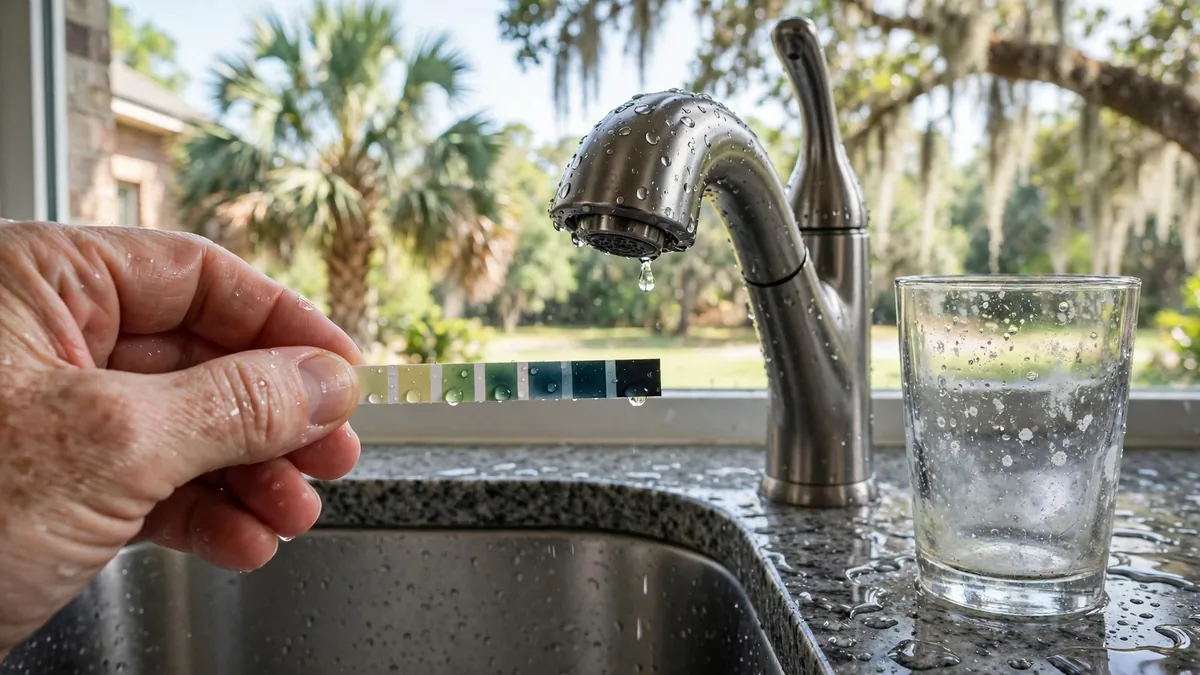
Test strips from a hardware store give a rough reading, and a lab test is better if you plan to spend real money on treatment equipment.
Not sure what your water needs?
Call with your utility's hardness number and we will tell you plainly whether a softener makes sense.
What each hardness band means for your house
These are commonly used bands. They show where a softener starts to make sense.
| Grains per gallon | Class | Typical effects |
|---|---|---|
| Under 1 | Soft | Little to no scale, soap lathers easily |
| 1 to 3.5 | Slightly hard | Mild spotting, heaters rarely scale |
| 3.5 to 7 | Moderately hard | Visible spots, some scale on heaters |
| 7 to 10.5 | Hard | Scale on fixtures and in heaters |
| Over 10.5 | Very hard | Heavy scale, appliance wear |
Who supplies your tap
The Midlands is a patchwork of systems. Columbia Water serves the city and parts of the surrounding area. Cayce runs its own plant on the Congaree River. West Columbia operates a plant too, and the Town of Lexington has bought water from it since 1999. A joint commission serves unincorporated parts of Lexington County, and some homes use private wells.
Your utility bill names your supplier. Ask that utility for its latest consumer confidence report and look for the hardness line, which often sits under secondary parameters.
Where the other numbers come from
Water hardness follows the rock and soil the source passes through. Surface water from rivers and Lake Murray tends to be lower in dissolved minerals than groundwater, which is why wells can differ sharply from the city supply. A well in the same neighborhood can read many times higher than the tap down the street.
If your water really is hard
Fixtures that crust over within days, a dishwasher that leaves film and a water heater that rumbles from scale all point to hard water. In that case a softener pays off, and the sizing depends on your measured hardness and household use. Our page on water softener installation and repair covers the install details.
If your complaint is taste or smell instead, hardness is not the culprit. See our page on water filtration for disinfectant taste.
How to test your own water
Three ways to measure hardness, from quick to precise.
| Method | How it works | Good for |
|---|---|---|
| Test strips | Dip a strip and compare the color | A fast ballpark number |
| Soap test | Shake water and soap in a bottle, watch the suds | A rough sense, not a measurement |
| Lab test | Send a sample to a certified lab | Buying equipment or testing a well |
| Utility report | Read the published hardness figure | City supply customers |
Spots are not always hardness
White film on glasses can come from hard water, but it can also come from a dishwasher that needs rinse aid or a detergent that does not dissolve well. Spots on a shower door may be soap scum, not scale. Before you blame the water, check your dishwasher settings and cleaning products.
A true hardness problem leaves hard, crusty deposits on faucets and kettles, and a water heater that rumbles from mineral buildup. Those signs together are more telling than spots alone.
Hardness and the water heater
Hard water builds scale in a heater and cuts efficiency. Soft water avoids that, but low-mineral water can wear down the sacrificial anode rod faster. Either way, a flush and an anode check every few years extends the tank's life. Our guide to water heater repair explains the parts involved.
If your system is on a private well in a place such as Lexington, the hardness may be far higher than the city number, and the heater may need more frequent care.
If you are on a private well
Wells draw groundwater that has been in contact with rock and soil for a long time, so hardness, iron and sulfur can be much higher than in surface water. Wells in the Midlands vary widely from one lot to the next. A lab test is the only reliable way to know what you have, and the result should guide any equipment you buy.
Iron stains orange and sulfur smells like rotten eggs, and neither is fixed by an ordinary softener alone. If you live on a well near Irmo or Lexington, test first and treat second.
What to do before you buy equipment
A short process saves money and keeps you from solving the wrong problem.
- Get your utility's report. Look for hardness in grains per gallon, ppm or mg/L.
- Test the tap yourself. A strip gives a quick check, and a lab test is more reliable.
- Match the number to the table above. Under 3.5 grains rarely justifies a softener.
- Ask what you are trying to fix. Spots, scale, taste and smell each need a different solution.
Water hardness questions
Columbia Water reports about 1 to 2 grains per gallon, which is soft. Other systems and wells nearby may differ.
Rarely at that level. A softener may still help with a specific appliance warranty or a measured hardness above about 7 grains.
Divide parts per million by 17.1.
Over years, it can leave scale inside pipes, heaters and fixtures and reduce efficiency. At the soft levels Columbia Water reports, that risk is low. A well or another system with harder water carries more of it.
Rarely. It adds cost, salt and maintenance for little benefit. If you see spots or film, check the dishwasher settings and rinse aid first, and test the water before buying equipment.