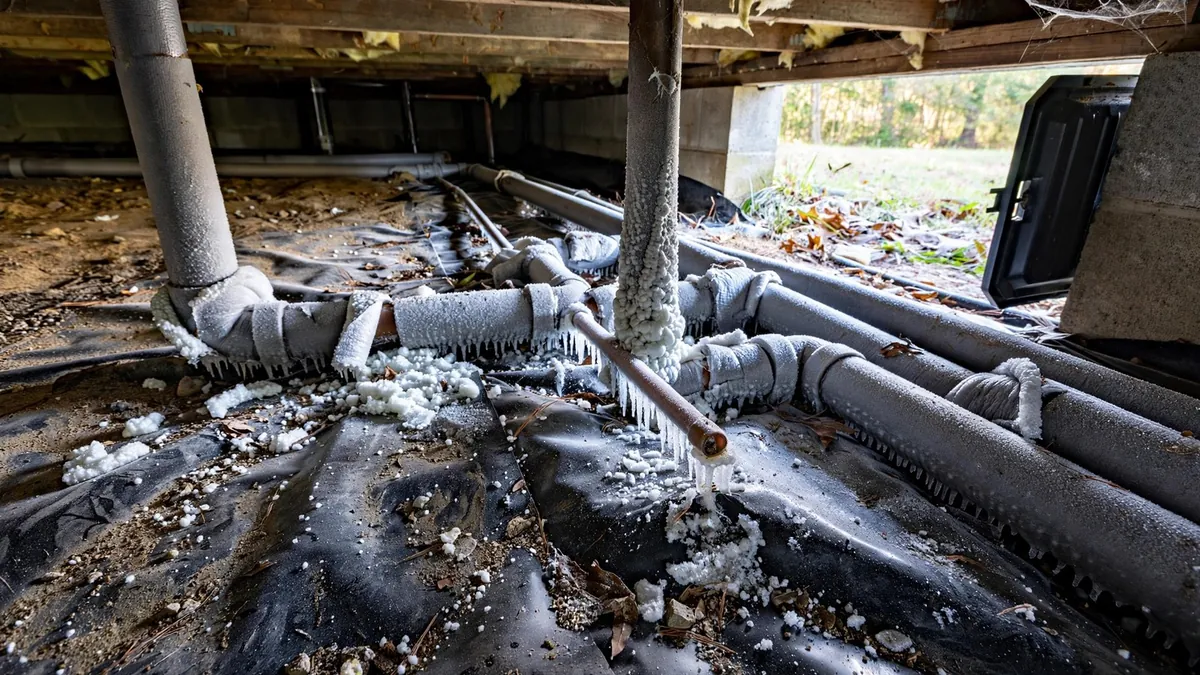
Why South Carolina pipes freeze at all
Heated rooms keep lines safe. Trouble starts in unheated crawlspaces, attics and exterior walls, where frigid air chills copper or plastic below freezing. Expanding ice cracks the tube, and the leak often appears only after the thaw, when flow resumes through the split.
Houses built for mild winters often have supply lines in the crawlspace or attic with little insulation, and the shutoff may be in an unheated closet. The International Plumbing Code (IPC) says supply pipes in exterior walls, attics and crawlspaces need protection from freezing, but older houses predate or sidestep that rule. That combination is why a single bad night can cause a flood in a state that rarely sees snow.
Where pipes freeze first
Check these places before a forecast freeze.
| Location | Why it freezes | What to do |
|---|---|---|
| Outdoor hose bibs | Exposed to wind and air | Disconnect hoses and cover spigots |
| Crawlspace supply lines | Cold air enters through vents | Insulate pipes and close vents on cold nights |
| Attic water lines | Little heat reaches the space | Insulate lines and the water heater closet |
| Pipes in exterior walls | Insulation may be thin | Open cabinet doors to let heat reach them |
| Garage supply lines | Unheated, drafty | Keep the door closed and insulate |
| Irrigation backflow assemblies | Exposed above ground | Drain or enclose them |
Pipe frozen or split?
Close the main if water appears and call.
A prevention checklist for the night before
Run through this when the forecast drops into the low twenties or teens for several hours.
- Disconnect and drain hoses. A hose left attached traps water in the spigot.
- Open cabinet doors on exterior walls. Warm room air reaches the pipes.
- Let a faucet drip. Moving water is harder to freeze, and a drip relieves pressure.
- Insulate exposed lines. Foam sleeves are cheap and quick.
- Keep the thermostat steady. Do not drop it far overnight.
- Know your main shutoff. If a pipe splits, you want it closed fast.
How to thaw a frozen pipe safely
If a faucet gives only a trickle on a freezing day, a pipe is probably frozen. Open the faucet so melting water can escape, then warm the pipe slowly with a hair dryer or a space heater set safely nearby. Work from the faucet back toward the frozen section.
Never use an open flame, a torch or a heater left unattended. Fire is a real risk around wood framing and insulation. If you cannot find the frozen section, or if you see a crack or a wet wall, close the main and call for burst pipe repair.
What happens when a pipe splits
Water may not appear until the ice melts. Then it can flow freely, so shut off the main as soon as you see a bulge, a crack or a wet spot. Photograph the damage, then call a plumber to repair the pipe and a restoration company to dry the structure if it is wet.
Wet materials should be dried quickly. EPA guidance says to dry within 24 to 48 hours to limit mold. Our page on water damage restoration explains the process.
Wind, vents and the crawlspace
Crawlspace vents let air circulate in warm months. On a hard freeze they let cold air in. Closing the vents or covering them on the coldest nights helps, and opening them again in spring keeps moisture from building up. Wind makes the effect worse, since moving air strips heat from a pipe faster than still air does.
Pipes along the north side of a house and in corners are exposed to the most cold. Look at where the supply lines run and which are close to an exterior surface.
Insulation materials that work
Insulation slows heat loss. It does not create heat, so a pipe in a very cold space can still freeze.
| Material | Good for | Notes |
|---|---|---|
| Foam pipe sleeves | Exposed copper or PEX | Cheap, slit and snap on, seal the seam |
| Fiberglass wrap | Larger pipes | Keep it dry, cover with tape |
| Heat tape | Problem spots | Use only products rated for plumbing and follow instructions |
| Foam covers for hose bibs | Outdoor spigots | Fast and low cost |
After the thaw: check for leaks
A pipe can split during a freeze and show nothing until the ice melts.
- Walk the house after the temperature rises. Look at ceilings, walls and floors for new stains.
- Check the crawlspace and attic. Water collects out of sight.
- Read the meter with everything off. A moving indicator means water is escaping.
- Listen for running water. A hiss in a wall is a clue.
- Open each faucet slowly. Sudden pressure can finish a weakened pipe.
A simple cold-snap kit
Keep foam covers for the hose bibs, a roll of pipe wrap, a hair dryer and a flashlight in one place. Add a flashlight and extra batteries too, because cold snaps often come with power outages. Write the main shutoff location on the kit lid, so anyone in the house can find it.
Manufactured homes, additions and exposed lines
Manufactured homes and room additions often have supply lines in an unheated belly or under the floor, where cold air gets in easily. Skirting that has gaps, torn belly wrap and missing insulation are the usual weak points. Repair the skirting before winter and keep a heat source rated for the space running on the coldest nights.
Additions built over a slab may route lines through exterior walls. If you have one, open the cabinet doors on cold nights and consider extra insulation behind the vanity.
Lake houses and empty homes
Vacation homes and rentals are at the highest risk, since nobody is there to notice a problem. Shutting off the main and draining the lines before a cold stretch is the safest practice. Houses along Lake Murray near Irmo often sit empty in winter, and a split pipe can run unnoticed for days.
Frozen pipe questions
Pipes in unheated spaces can freeze when temperatures stay below about 20 degrees for several hours. Wind makes it worse.
On very cold nights, yes, especially for lines on exterior walls.
No. Use warm air, never an open flame.
PEX is more flexible and tolerates some expansion, so it is less likely to split. It can still freeze and block flow, and fittings can fail, so insulation and care in cold spaces still matter.
Yes. Set the thermostat to a safe minimum, commonly around 55 degrees, and ask someone to check the house during hard freezes. Shutting off the main and draining the lines is the stronger choice for a long absence.