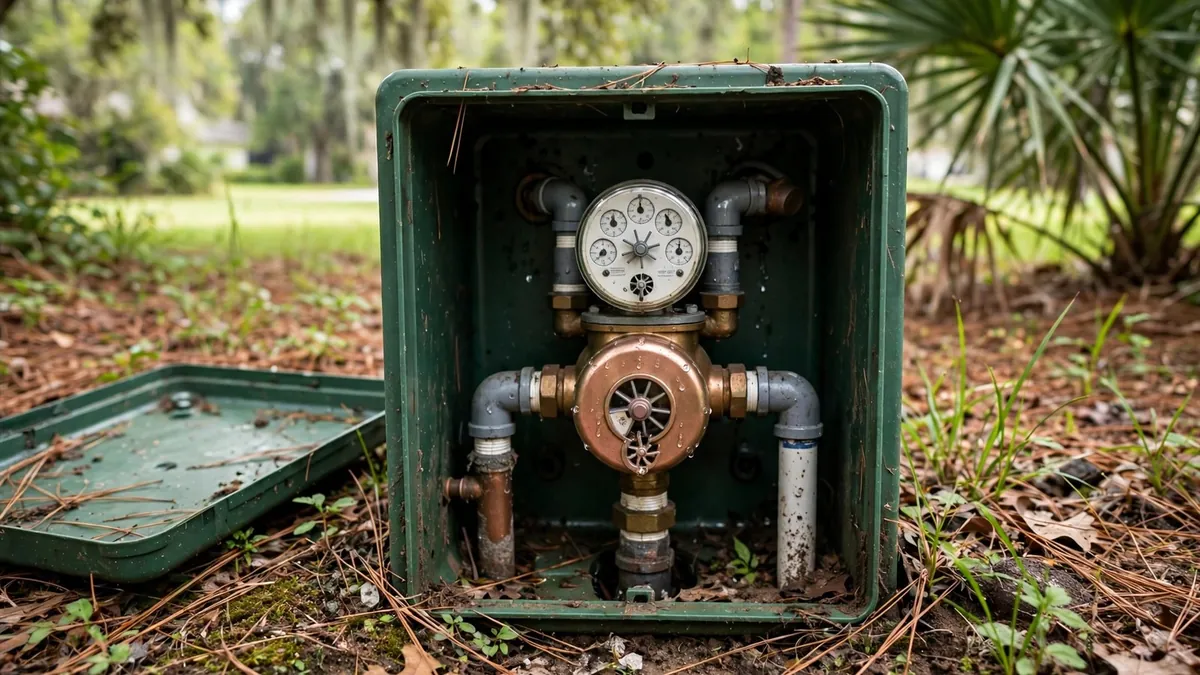
Start with the meter, not the bill
A water bill is a record of what passed through your meter. If the number is high, either more water went through it, or the meter recorded it differently than before. Both are worth checking, and they have different owners.
Columbia Water has told local reporters that its responsibility ends at the meter. Everything after it, including the pipe to the house, the fixtures and the irrigation system, belongs to you. That is why the first job is to learn whether water is still moving after the meter when you are using none.
Common causes of a sudden jump, and how to check each
Most high bills trace back to a short list of causes. This table pairs each with a quick check.
| Cause | Quick check | Who fixes it |
|---|---|---|
| Leak between the meter and the house | Meter moves after you close the main inside the house | Plumber |
| Leak inside the house | Meter stops when you close the main | Plumber |
| Running toilet | Dye in the tank shows up in the bowl | Homeowner or plumber |
| Irrigation or a stuck zone valve | Meter moves only when the controller is on | Irrigation contractor or plumber |
| A catch-up bill after estimated reads | Earlier bills were marked estimated | Ask the utility |
| A meter error | No leak found and usage still looks wrong | Utility tests the meter |
Meter moving with everything off?
Call with the reading and we will plan how to find the leak.
The ten-minute test
Do this when the house is quiet, ideally at night, and write the numbers down.
- Turn off everything that uses water. That includes the ice maker, the washer, the dishwasher and any irrigation controller.
- Open the meter box. Lift the lid carefully and look for spiders and snakes before you reach in.
- Find the leak indicator. It is a small dial, star or triangle that turns when any water moves.
- Photograph the reading. Take a picture of the register and the indicator, with a timestamp.
- Wait fifteen minutes and look again. A moving indicator or a changed register means water is still flowing.
- Close your main valve and check once more. If the movement stops, the leak is inside the house. If it continues, it is between the meter and the house.
What changed in Columbia: the meter upgrade
Columbia Water spent several years replacing its meters with automated models that send readings by radio. A city official told The Post and Courier in 2022 that the program covered more than 150,000 meters at a cost of $45 million. The new meters can flag continuous flow, and customers can follow usage through the utility's online account or its app.
The change also explains some surprises. The utility said in 2020 that bills based on estimates could be followed by a larger bill when a real reading arrived, and that older meters can run slow and under-record. None of that means your bill is wrong. It does mean a jump after a meter swap deserves a careful look, with your own readings in hand.
Toilets and irrigation are the quiet culprits
In one Columbia case reported by WIS in 2021, a household was losing about 18 gallons an hour. That works out to roughly 13,000 gallons a month. The source was a running toilet, which is a flapper that does not seal.
Lawn systems are the other usual suspect in the Midlands, where summer watering is heavy. A cracked lateral or a valve stuck open can run for weeks without any wet spot showing. Run the meter test with the irrigation controller off, then switch one zone on at a time and watch the dial.
Why sewer charges can rise with the water
Columbia Water provides drinking water, wastewater and stormwater service, and wastewater charges are commonly tied to the water you use. A leak that never reaches a drain can still inflate that line. Ask the utility how your bill is built, and ask whether any adjustment applies when a leak has been found and repaired.
Asking the utility for help
Call the Columbia Water customer care line at (803) 545-3300 and ask for a review of the readings. Have your photos, the dates of any meter change and the repair invoice ready. If you suspect the meter itself, ask for a test. The utility has said it has a testing process and will tell you whether the device is working to standard.
Many utilities offer an adjustment process for verified leaks. Ask yours about it before you pay for repairs, so you know what documents to keep.
Reading the usage line on your bill
Look for the units first. Many utilities bill in hundreds of cubic feet, written as ccf, and one ccf equals about 748 gallons. A bill that jumps from 5 ccf to 11 ccf means roughly 4,500 additional gallons, which is easier to picture than the raw numbers.
Compare the month to the same month last year, not just to last month. Summer watering, guests and a new baby can each shift usage for good reasons, and a year-over-year comparison separates habit changes from true anomalies.
Keep a one-month log
If the test turns up nothing and the bill still looks wrong, a log gives the utility something concrete to review.
- Read the meter at the same time each day. Evening, after the last shower, works well.
- Write down the date and the register number. A phone photo with a timestamp is just as good.
- Note unusual water use. Filling a pool, hosing the driveway or running a new appliance all count.
- Calculate daily usage. Subtract each reading from the next and divide by the days between them.
- Bring the log when you call. It turns an argument about a bill into a discussion about numbers.
When it is time to call a plumber
If the meter keeps moving after you close the main, the leak is in the line from the meter. Our page on water line repair explains how those are found and fixed. If the meter stops, the leak is inside, and leak detection can pinpoint it without opening walls. Older houses in Forest Acres are a common place for inside leaks to hide.
Questions about a high water bill
Yes. More people at home, a new appliance, summer watering or a catch-up after estimated bills can raise usage without a leak.
The property owner. The utility's responsibility generally stops at the meter, so repair costs fall to you.
Run the meter test. If no water moves with everything off and the register matches your readings, ask the utility to test the meter.