Leak Detection in Columbia, SC
The meter dial turns while every faucet is off, the bill climbs and no ceiling stain shows. Locating escaping water takes listening gear, thermal imaging and pressure tests, not demolition.
- Meter test guidance
- Non-invasive tools
- Walls, slabs and yard lines
My bill doubled and nothing is dripping: what is going on?
Most hidden leaks announce themselves indirectly. These are the common clues and what each one usually means.
A bill that jumps with no change in habits
Water is leaving the system somewhere after the meter. Irrigation, slab lines and toilets are the usual suspects.
The meter moves with every fixture off
That confirms a leak. The next question is whether it is inside the house or in the yard line.
A warm spot on the floor
A hot-water line under the slab can warm the surface above it.
Mildew smell, bubbling paint or a damp baseboard
Water is reaching a wall or floor from a line you cannot see.
A ten-minute meter test you can do yourself
Before you pay for anything, confirm there is a leak.
- Turn off every fixture. Include the dishwasher, washer, ice maker and irrigation.
- Find the meter. It is usually near the street in a ground box. Lift the lid carefully.
- Read the leak indicator. Most meters have a small low-flow dial or triangle that spins when any water moves.
- Wait fifteen minutes and look again. Any change in the reading means water is leaking.
- Close the main and test again. If the meter stops, the leak is inside the house. If it keeps moving, it is in the line from the meter.
Meter running with everything off?
Call with the meter reading and we will plan how to pinpoint the leak.
How hidden leaks are located
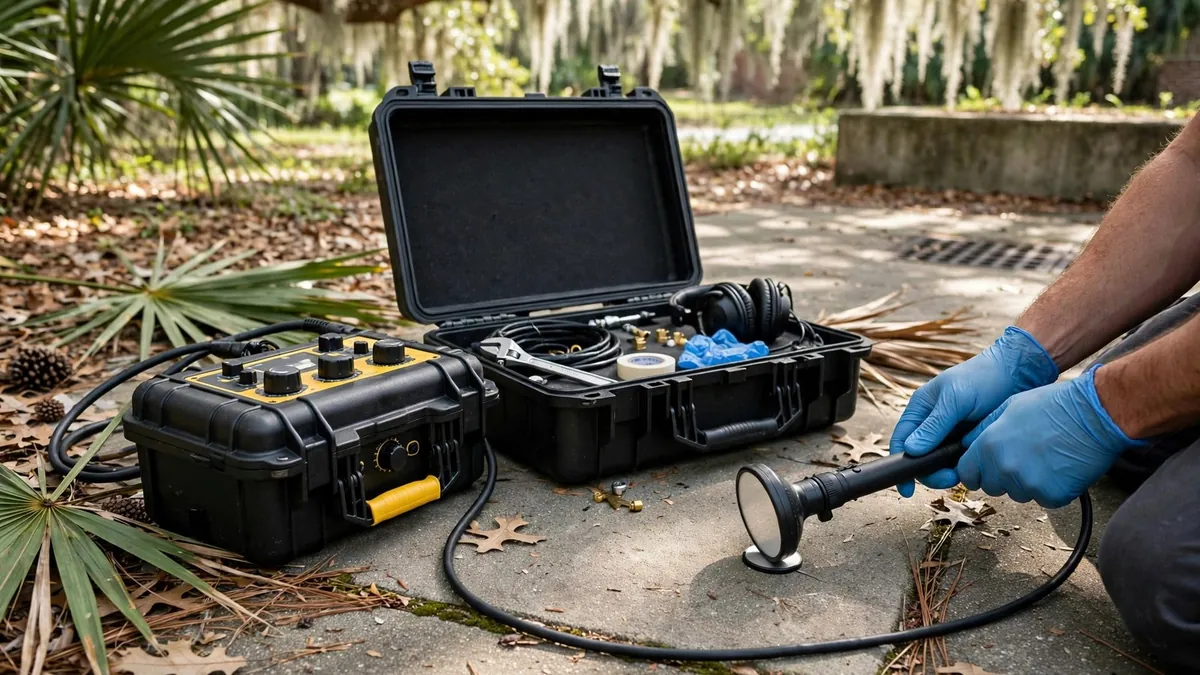
Technicians use several non-invasive tools and pick the one that fits the suspected location.
| Method | What it does | Best for |
|---|---|---|
| Acoustic listening | Detects the sound of water escaping a pressurized pipe | Slab and buried lines |
| Thermal imaging | Shows temperature differences from wet or hot lines | Walls, ceilings, radiant floors |
| Pressure testing | Isolates a line to see if it holds pressure | Confirming a failed segment |
| Tracer gas | Injects a harmless gas that escapes at the leak | Hard-to-hear leaks in sealed lines |
| Camera inspection | Looks inside drain lines and accessible spaces | Drain and sewer leaks |
Where leaks hide in Columbia-area houses
Mid-century houses in Forest Acres often have galvanized supply lines and original water heater closets, which are common leak spots. Newer homes in Lexington more often leak at fixtures, hoses and water heater connections.
Yard irrigation is another frequent culprit in the Midlands, where lawns are watered hard through summer. A broken irrigation lateral or a stuck valve can run for weeks before the bill shows it.
Why pinpointing matters more than patching
Opening walls on a guess is expensive and often wrong. A precise location means a small opening, a targeted repair and less restoration. Keep the meter readings you took, because they help an insurer or utility understand the timeline of a leak.
Ask your utility whether it offers any adjustment on a bill inflated by a verified leak. Policies differ, and the repair invoice is usually part of the paperwork.
Irrigation, pools and other leaks that hide outside
Lawn irrigation is a common source of hidden water loss, because a broken lateral or a stuck zone valve can run for weeks. Try the meter test with the irrigation controller off, then with it on.
A pool with an autofill valve can also hide a leak behind the water level. The International Plumbing Code (IPC) requires new water piping to be pressure tested before it is concealed, and the same kind of test is how a technician proves an older line holds.
A leak bill in Columbia: who handles what
Columbia Water owns the service line only up to the meter, so a leak after it belongs to the owner. Its free EyeOnWater app tracks usage and sets leak alerts, and Customer Care is at (803) 545-3300. Columbia Water draws from the Broad River Diversion Canal and Lake Murray, and its meter is your first clue.
Galvanized lines in mid-century Richland County homes and hoses and fittings in newer Lexington County houses near Irmo can both hide a slow leak. EPA figures say household leaks can waste nearly 10,000 gallons of water a year.
How much a small leak really wastes
The Environmental Protection Agency estimates that about 10 percent of homes have leaks wasting 90 gallons or more per day. A faucet dripping once per second can waste more than 3,000 gallons in a year. A toilet flapper that sticks open can lose water silently, which is why the dye test and the meter test come before any digging.
Four tests that narrow a hidden leak
Start with the meter, since a dial that moves with every fixture off confirms a leak after the meter. Then drop a few drops of food coloring into each toilet tank and wait without flushing. Color in the bowl means a leaking flapper.
Next, close the main valve for an hour and read the meter again, then close individual shutoffs to see which branch is losing water. A pressure gauge on a hose bib shows whether the system holds pressure. Each test removes part of the house from the search.
Reading your Columbia Water bill after a leak
Columbia Water bills in units of 100 cubic feet, and one unit is about 748 gallons, so a jump of a few units is a lot of water. Its customer guide describes a plumbing repair adjustment for customers whose usage returns to normal after a repair. The adjustment is limited to three months and one adjustment in any 12-month period.
Keep the plumber's invoice and the dates of the repair, since the utility reviews the account only after the repair is complete and usage has settled. The guide also points customers to its free EyeOnWater app for tracking daily use and setting leak alerts.
The usual hiding places for a leak
Many leaks sit in the places nobody looks. Washing machine hoses, ice-maker lines, toilet supply lines and water heater connections fail slowly and often leak onto a floor you do not inspect. Irrigation lines are another source, since a buried break can run for weeks.
Supply pipe inside walls and under slabs is harder to find, and the signs are indirect, such as a damp spot, a musty smell, warm floor tiles or the sound of running water at night. Tell the technician about any of these when you call, and which fixtures or appliances sit closest.
What the report should include
A useful leak detection report names the method used, the location of the leak in plain terms and the readings that support it. It also states which lines were tested and which were cleared.
Keep it with your records. If the leak led to damage, the report supports an insurance claim and helps a later buyer understand what was found and repaired.
Finding hidden leaks in century-old neighborhoods
Houses in Shandon, Earlewood and Elmwood Park have been repiped, patched and added onto over a century, so a hidden leak can sit behind plaster or under a later addition. Acoustic listening and a thermal camera narrow it to a small spot before any wall is opened.
Rural addresses in Hopkins and Chapin have the opposite problem, a long buried line. A meter test shows whether water is escaping between the meter and the house before anyone digs.
What changes the price of leak detection
Detection is priced by the effort needed to find the leak.
Many homeowners policies cover resulting water damage but not the cost of locating the leak. The details vary, so ask your insurer before work starts.
Want your real number? Call (844) 981-1691 and mention suspected location and size of the property.
Where a confirmed leak goes next
A confirmed leak under concrete moves to slab leak repair. A leak in the line from the meter is a job for water line repair. A leaking pipe that is actively flooding is a burst pipe emergency.
Leak detection questions
Run the meter test above. If the meter moves with every fixture off, water is leaking after the meter.
Not at first. Acoustic and thermal tools narrow the location so any opening is small.
Yes. A small continuous leak can add up quickly because the meter charges for water that never reaches a fixture.
It can be. A flapper that does not seal lets water trickle into the bowl. Add dye to the tank to check.