Slab Leak Detection & Repair in Columbia, SC
Warm tile, a faint hiss at 2 a.m. and a meter that will not rest suggest a pressurized pipe leaking inside or beneath the concrete floor.
- Acoustic detection
- Spot repair or reroute
- Floor protection
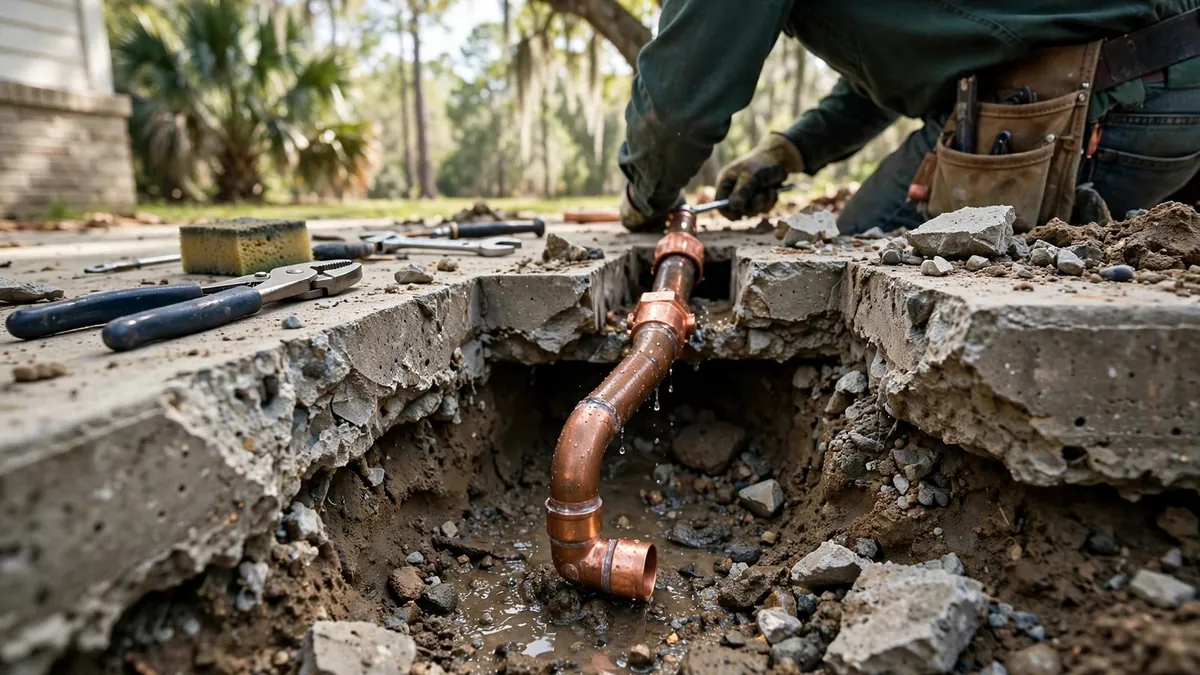
Signs of a leak under the slab
Concrete hides the pipe, so the evidence is indirect: heat, sound, bills and mildew.
A warm patch on the floor
A hot-water line leaking under the slab heats the concrete above it.
The sound of running water at night
A faint hiss when every fixture is off is a strong clue.
A meter that moves with fixtures off
Water is escaping somewhere after the meter.
Cracks, damp carpet or mildew at floor level
Moisture is reaching the surface from below.
Repair options compared
Once the leak is located, there are three realistic approaches.
| Option | How it works | Best when |
|---|---|---|
| Spot repair through the slab | Cut a small opening and repair or replace the failed segment | One accessible leak in sound pipe |
| Reroute overhead | Abandon the slab line and run new pipe through walls or attic | Repeated slab leaks or hard access |
| Repipe the house | Replace the supply system with new pipe | The pipe is old and several lines are failing |
Rerouting and repiping are closely related, and our repiping page explains materials and timing.
Suspect a leak under the floor?
Call with your meter reading. A moving meter with everything off is the first proof.
Finding the leak without breaking concrete
Technicians listen for the sound of water along the slab with acoustic gear and often confirm with a pressure test on isolated lines. Thermal imaging helps with hot-water lines. The goal is to mark the leak within a small area so the concrete opening is the size of a hand, not a room.
Start with the meter test on our leak detection page, because a slab leak and a yard line leak look alike from the outside. Replacement pipe must meet the International Plumbing Code (IPC) as South Carolina adopts it.
Why slabs matter in the Midlands
Many Midlands houses sit on concrete slabs or over crawlspaces, because full basements are less common here than in northern states. In a slab house, supply or drain lines may run in or under the floor.
Cayce and Forest Acres have many mid-century houses where the original galvanized or early copper lines are now seventy years old. Age and soil movement are the usual reasons a slab line fails.
Protecting floors and paperwork
Ask before work starts how flooring will be protected and who is responsible for putting tile or wood back. Take photos of the floor before any cutting.
Insurance often covers the resulting damage and sometimes the cost of getting to the pipe, but it rarely covers the pipe itself. Keep the detection report, since it documents the cause.
What to do while you wait for the slab leak repair
A few steps limit the cost until the leak is fixed.
- Turn off the main when no one needs water. A running slab leak is wasting water and soaking the soil.
- Keep a record of the meter. Photos with the date prove how long the leak ran.
- Watch the floor. New dampness, warm spots or mildew mean the leak is spreading.
- Move belongings off the affected floor. Dry goods are easier to save than wet ones.
Slab leaks and Midlands soils
Houses on slabs or crawlspaces are common in Richland and Lexington counties, and ground near the Congaree River and Gills Creek has flooded before. Your Columbia Water meter shows whether flow is continuous, and a slab leak report that records the meter readings helps with insurance.
How a slab leak is confirmed before anyone cuts concrete
Start with the meter test. If the dial moves with every fixture off, water is escaping somewhere after the meter, and a warm patch on the floor points at a hot line. A pressure gauge on a hose bib then shows whether the lines hold pressure once the house is isolated.
Acoustic listening gear and thermal imaging narrow the location to a few feet. The goal is one small opening in the right place, not a trench across the living room. A written location and the meter readings also help if you file an insurance claim.
Spot repair, reroute or repipe
A spot repair breaks the slab over the leak, replaces the damaged section and patches the concrete. It suits a single failure in an otherwise healthy line. A reroute abandons the leaking run and installs a new line through the attic or walls, which avoids further work under the floor.
When the same house has had several leaks, a repipe replaces the supply system so the slab is not opened again. The choice depends on pipe age, how many leaks there have been, and what covers the floor. Ask for the options with prices before you decide, as the numbers differ more than people expect.
What your foundation says about the risk
Many older Midlands houses sit on crawlspaces, while newer subdivisions in Lexington and Irmo more often use slabs, so a slab leak is partly a question of what your house is built on. Clay soil also swells and shrinks with wet and dry cycles, and a shifting slab can stress pipe that was installed tight against it.
If you suspect a leak under a slab, shut off the main when the house is empty and watch the meter. A fast, steady drain on the bill is also a sign, which is why leak detection often comes first.
Insurance, floor coverings and what to expect on the day
Policies handle slab leaks differently, so read the sections on water damage and on access to the leak. Some pay for the plumbing repair and the cost of reaching the pipe, while others pay only for resulting damage. Ask your insurer before work starts, and keep the detection report and meter readings.
Floor coverings change the job. Tile and carpet are usually lifted and reset or replaced, while hardwood and engineered flooring are harder to match after a cut. Expect noise and dust on repair day, a short period without water to the house, and a patched slab that cures before flooring goes back.
Why catching it early matters
Water under a slab can soften the soil, lift flooring and feed mold in the wall base. The bill also climbs every day the leak runs.
Warm spots on the floor, the sound of running water when everything is off and a meter that never rests are the signs worth acting on. Shut off the main if you leave the house for a long time and call the same day if the meter keeps moving. A short delay to book the work costs far less than months of unnoticed loss.
Questions to ask before you approve the work
Ask how the leak was located and whether the technician can show the readings. Ask what the opening will measure and how the floor and slab will be patched. Request the price for a spot repair and for a reroute side by side.
Also ask whether the work needs a permit and whether the lines will be pressure tested before the slab is closed. Clear answers to those questions are a good sign that the crew has done the job before.
Slab leaks in the northeast suburbs
Subdivisions built on slabs since the 1980s fill the northeast side of the county, from Dentsville toward Lake Carolina and Blythewood. Copper lines under a slab can pinhole with age, and gray polybutylene in the oldest of those houses adds another risk.
A hot spot on tile, or the sound of running water with every fixture off, should start the investigation. Our Northeast Columbia page explains the housing in that part of town.
What changes the price of a slab leak repair
Slab work is priced by access and by how much pipe is involved.
Ask whether the quote includes patching the concrete and the floor covering. They are often separate lines.
Want your real number? Call (844) 981-1691 and mention depth and location and flooring.
Other work linked to a slab leak
A leak inside a wall is a burst pipe repair job. If water has soaked the floor, water damage restoration covers the drying.
Slab leak questions
Close the main shutoff inside the house and watch the meter. If it stops, the leak is inside. If it keeps moving, it is in the line from the meter.
A long-running leak can wash out soil under the slab. It is one reason not to wait.
Sometimes by rerouting the line overhead. A spot repair through the slab is also an option once the leak is located.
Usually. The meter should stop moving with the fixtures off.