Backflow Testing & Prevention in Columbia, SC
Backflow protection keeps contaminated water from flowing backward into the public supply. South Carolina requires water systems to run cross-connection programs, and assemblies must be tested by a state-certified tester.
- Irrigation and commercial
- Install and replace assemblies
- Annual test guidance
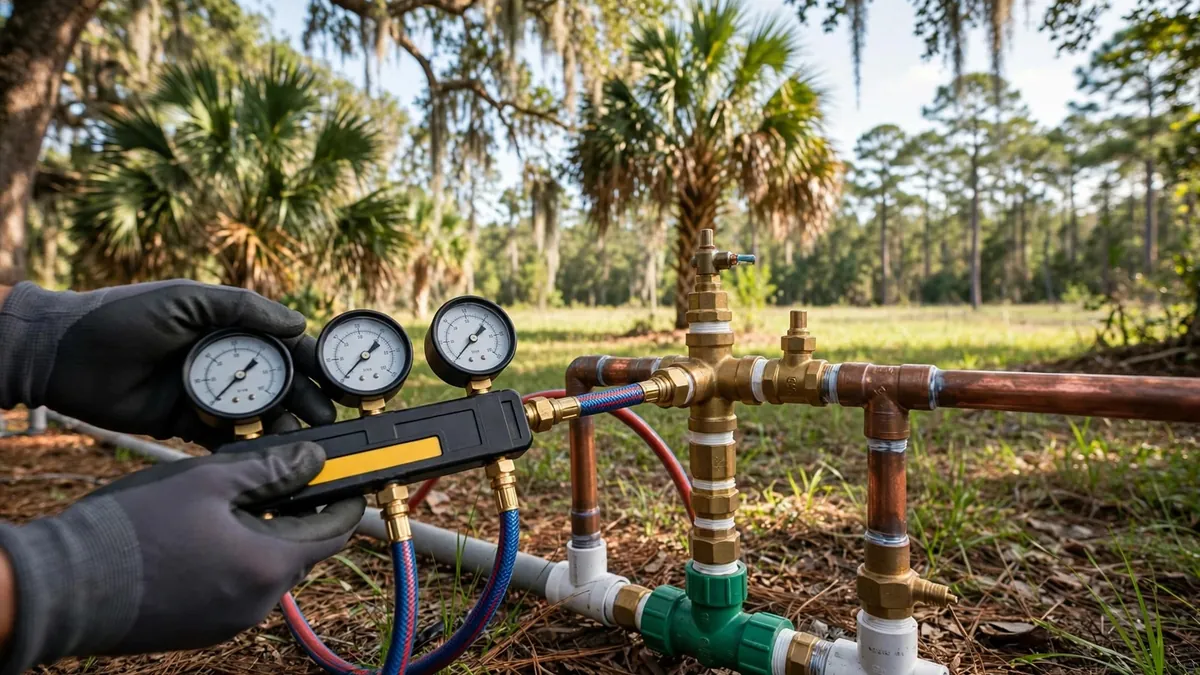
Who needs a backflow assembly
You may not have heard the term until a notice arrived. These are the usual situations.
A lawn irrigation system
Sprinklers can pull ground water back toward the supply, so the rules call for a protective assembly.
A commercial building or restaurant
Boilers, dishwashers and mixing equipment create cross-connections.
A fire sprinkler line
Standing water in fire lines needs isolation from the potable supply.
A utility notice about annual testing
Water systems track assemblies and require yearly test reports.
Assembly types and where they are used
The hazard level decides the type of assembly.
| Assembly | Typical use | Notes |
|---|---|---|
| Atmospheric vacuum breaker (hose bibb) | Outdoor spigots | Low cost, protects hose connections |
| Pressure vacuum breaker | Irrigation systems | Installed above the highest sprinkler head |
| Double check valve assembly | Lower-hazard lines | Two check valves in series |
| Reduced pressure principle assembly | Higher-hazard lines | Used for health hazards like chemicals |
Got a test notice from your water utility?
Call with the notice and the assembly type and we will explain the next step.
What South Carolina requires
South Carolina Regulation R.61-58.7(F) requires every public water system to maintain a cross-connection control program. A state-certified tester must do the testing, and assemblies used in the state must appear on the approved list kept by the Department of Environmental Services. Certified testers renew their certification every three years.
Ask any provider to show their state tester certification before you pay for a test or accept a report. A report from an uncertified tester does not satisfy the utility.
Water backflow is not the same as sewer backup
The word backflow covers two different problems. Supply backflow is contaminated water entering the drinking water system. Sewer backup is sewage coming up through floor drains during storms. The cross-connection program regulates the first. A backwater valve on the sewer line addresses the second, which our sewer line repair page touches on.
During the October 2015 flood the Columbia Canal breached and the city issued a boil-water advisory, a reminder of why the supply side of the system is protected.
Installing or replacing an assembly
An assembly must be installed in the right orientation, at the right height and with proper clearance for testing. Freezing and heat both damage them, so some are wrapped or enclosed in a hot box.
A failed test usually means worn check valves or seals, which are replaceable in many assemblies. If the assembly is old or undersized, replacement is cleaner than repeated repairs. Irrigation customers in Irmo and Lexington are the ones we hear about most.
Irrigation season checklist
A little care keeps an irrigation assembly passing its annual test.
- Test at the start of the season. Schedule the test before the system runs hard, so repairs do not wait until July.
- Protect the assembly from freezing. Drain it before a hard freeze or cover it with an insulated enclosure.
- Keep the area clear. Shrubs and mulch around the assembly hide leaks and block access.
- File the report. Send the test report to the water utility and keep a copy.
Which office to call in the Midlands
The South Carolina Department of Environmental Services publishes the approved assembly list and certifies testers. Your own water utility, such as Columbia Water or the City of Cayce, sets the schedule and receives the report. Lawn irrigation systems in subdivisions across Richland County and Lexington County, including those around Lake Murray, are the usual residential assemblies.
Big properties, small yards and the same rule
Large properties are where backflow rules matter most. A zoo of 170 acres like Riverbanks, or an installation of more than 52,000 acres like Fort Jackson, shows how many irrigation and fire lines a big property can carry. Homes and small businesses carry the same duty on a smaller scale.
Lawn systems around Lake Murray tie into house water, and each assembly needs a test by a certified tester. Keep the report for your records.
What changes the price of backflow work
Testing and replacement are priced separately.
Insurance does not cover testing. Skipping a required test can bring fees from the utility, so keep the report.
Want your real number? Call (844) 981-1691 and mention test only or repair and assembly type and size.
When a failed test leads to other work
Businesses with many assemblies should read our commercial plumbing page. A leak at the assembly itself is a leak detection question.
Backflow questions
Utilities set the schedule, and annual testing is standard for assemblies on their cross-connection programs.
A state-certified tester. Ask to see the certification.
Usually yes. Your utility sets the policy and may specify the type.
The tester repairs or replaces it, retests it, and sends the report to the utility.