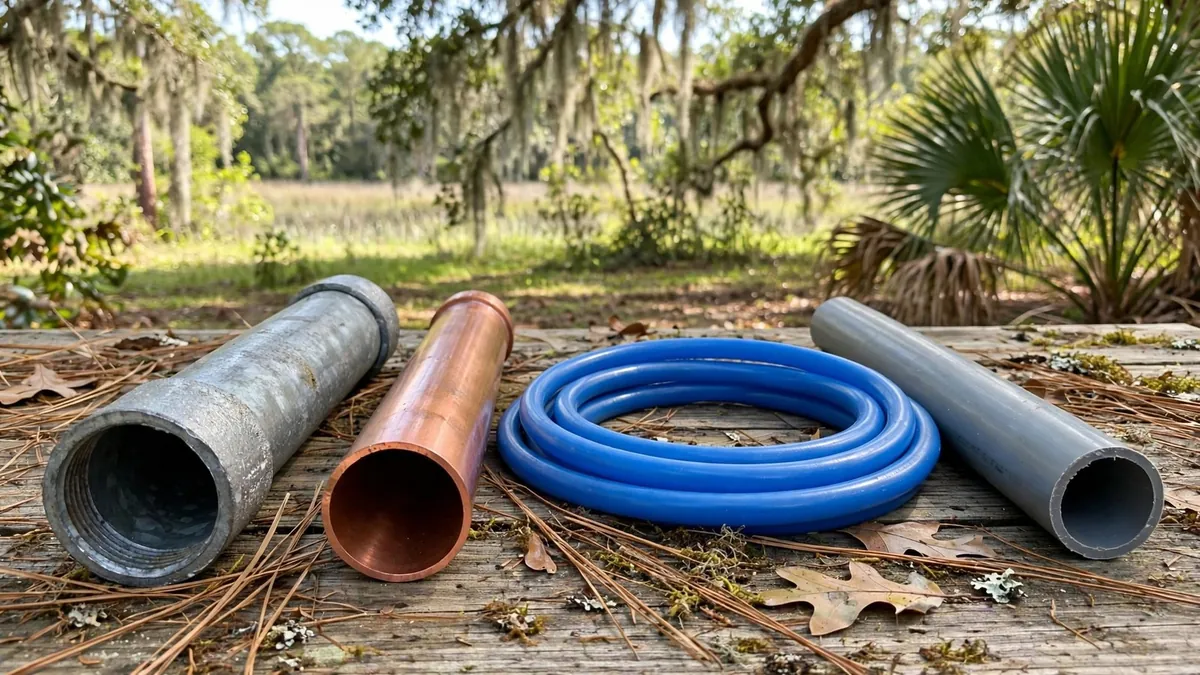
Where to look
Start where the pipes are exposed. The best places are around the water heater, near the main shutoff where the line enters the house, under kitchen and bathroom sinks, and in the crawlspace or garage. Look at the part of the pipe, not at a fitting or a valve, since fittings are often a different material.
Take photographs with a phone flashlight. If you call a plumber later, a clear picture of the pipe and any printed markings answers half the questions on the first call.
A field guide to supply pipe materials
Match what you see to a row. The age range is a rough guide, not a rule, because repairs mix materials.
| Material | How it looks | Typical use | Quick test |
|---|---|---|---|
| Galvanized steel | Dull gray, threaded joints, often rusty | Many homes before the 1960s | A magnet sticks |
| Copper | Orange-brown or green with age, soldered joints | 1960s to today | A magnet does not stick, a scratch shows bright metal |
| CPVC | Cream or tan plastic, rigid | 1980s to today | Snaps when cut, solvent-welded joints |
| PEX | Flexible tubing in red, blue or white | 1990s to today | Bends in a gentle curve, crimp or clamp fittings |
| Polybutylene | Gray, blue-gray or black flexible plastic | About 1978 to 1995 | Often stamped with PB2110 |
Found gray plastic or rusty steel pipe?
Call and describe what you see. We will tell you if it needs attention.
Polybutylene: the one to take seriously
Polybutylene was widely installed from the late 1970s into the mid-1990s and is known for failing at fittings. Look for markings that include PB or the code PB2110 printed along the pipe. The plastic fittings and copper crimp rings at connections are another giveaway.
Not every house with polybutylene has leaked, but a failure can send a lot of water into a wall. Houses built in that window, including many in Irmo, are worth checking near the water heater and main shutoff. If you find it, ask about repiping before a fitting decides the timing for you.
Galvanized steel and what its age means
Galvanized steel is coated with zinc, and that coating wears away from the inside. A magnet tells you quickly, and so does a scratch with a key, which shows dull gray steel instead of copper-colored metal. Brown water that clears after a minute and weak pressure at older fixtures are the classic signs.
Galvanized pipe commonly lasts 40 to 50 years. Mid-century neighborhoods like Forest Acres fit that window, so a scratch test is worth doing before you fix one leak at a time.
Copper, CPVC and PEX: the later generations
Copper has the longest track record. It can develop pinholes in some water conditions and its joints can fail, but it generally ages well. CPVC is a cream-colored plastic that can turn brittle with age and heat. PEX is flexible, handles cold well and uses fewer joints, which is why many modern repipes use it.
Columbia Water is soft and disinfects with chloramine. Both facts are compatible with all three materials, though the rubber seals in fittings and fixtures are where chloramine tends to show wear.
Drain pipes are a different story
Supply pipes bring water in. Drain pipes carry it out, and they are made of other materials. Black, heavy cast iron appears in mid-century homes. White or gray PVC is common in newer ones. Clay pipe and fiber conduit sold as Orangeburg pipe appear in older sewer laterals. If a drain keeps clogging, a camera look at the lateral tells you which one you have. See sewer line repair for what that involves.
Copper grades and PEX markings
Printed or color-coded markings tell you more than appearance does.
| Marking | What it means | Where you see it |
|---|---|---|
| Green, blue or red stripe on copper | Type K, L or M wall thickness | Along the pipe |
| Red or blue PEX tubing | Hot and cold identification | Whole runs |
| PEX-A, PEX-B or PEX-C | The manufacturing method | Printed on the tubing |
| ASTM F876 or F877 | Standards for PEX tubing and systems | Printed on the tubing |
| PB2110 | Polybutylene tubing | Stamped on the pipe |
Why mixed metals matter
Where copper meets galvanized steel, the two metals can react and corrode, especially when water moves through them. Plumbers use dielectric unions or special fittings to separate them. A fitting that looks green or white and crusty at a transition is a sign of this reaction.
If you find a transition with heavy corrosion, mark it with a photo and mention it when you talk to a plumber. These spots often leak first.
When to pay for a professional opinion
You can identify most pipe by eye, but a plumber can see more. A camera in a wall cavity or a pressure test can show corrosion you cannot see. Ask for one if you are buying an older house or planning a remodel that opens walls. Our page on leak detection explains how hidden problems are found.
Taking photos a plumber can use
Use the flash, shoot from two angles and include something for scale, such as a coin or a tape measure. Capture any printed text on the pipe, the fittings at each end and the shutoff valve. A wide shot showing where the pipe sits in the house helps just as much as a close-up.
How long each material tends to last
Galvanized steel commonly lasts 40 to 50 years. Copper commonly lasts 50 years or more, though water chemistry and workmanship change that. PEX has been installed widely since the 1990s, and gray polybutylene was used from roughly 1978 to 1995. Matching your pipe to the right row tells you how much of its life is left.
If your pipes sit near the end of that range, document what you find with photos, ask your insurer whether your policy treats old plumbing differently. Then ask a plumber for a repair or repipe price and a schedule before a leak sets one for you.
What to do with what you find
Your findings decide the next step.
- Copper, CPVC or PEX in good condition. Nothing to do. Note the material for your records.
- Galvanized steel with brown water or low pressure. Plan a repipe consultation.
- Polybutylene. Ask a plumber about replacement and check your insurance policy.
- A mix of materials. Look closely at the transitions, because dissimilar metals corrode where they meet.
Pipe identification questions
It is no longer installed, but existing pipe is not banned. It is still a known risk, so many owners replace it.
A magnet sticks to galvanized steel and not to copper. A scratch also shows the color.
Not always. A plumber can assess condition and may suggest replacing the worst runs first.
Not reliably. Look at exposed sections near the water heater, the main shutoff and under sinks. A camera inspection or a plumber's opinion helps when everything is behind drywall.
It gives a hint, not an answer. Repairs and remodels mix materials, so a 1960s house may have galvanized steel in one wall and copper in another.