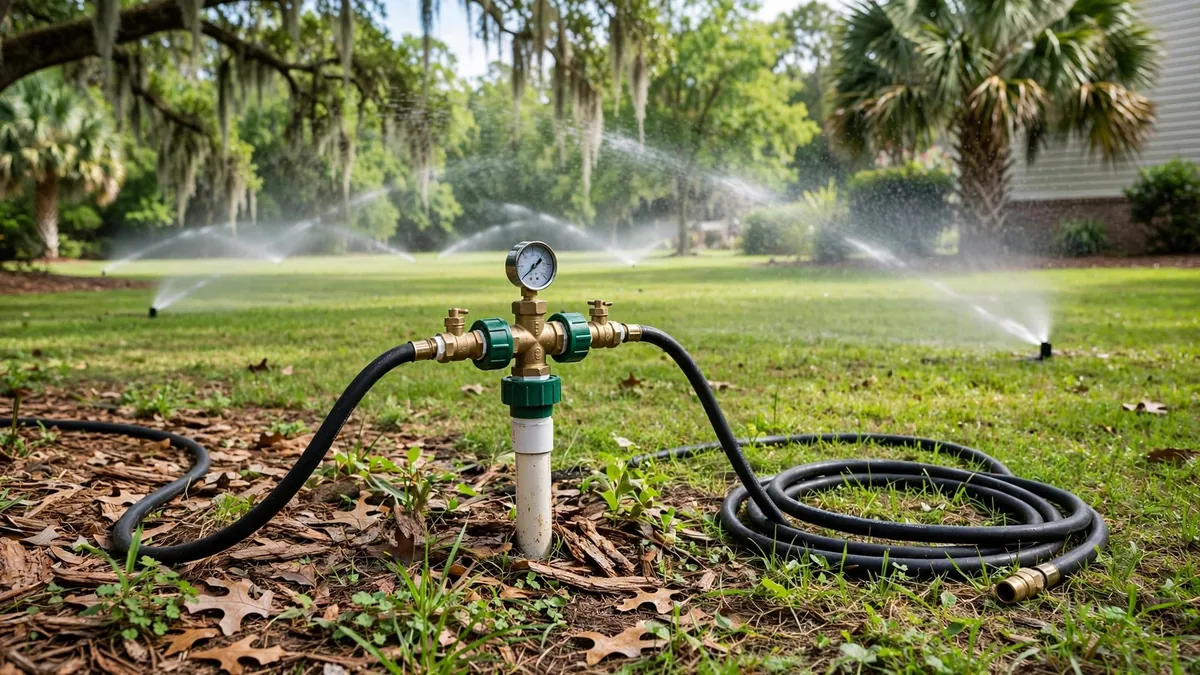
Why sprinklers need protection
A lawn system holds water that sits in the ground, near fertilizer, pesticides and animal waste. If pressure in the street drops during a main break or heavy use, that water can be pulled back into the drinking supply. A backflow assembly is a set of check valves or a vacuum breaker that prevents it.
The assembly is the only thing standing between your yard and your neighbors' tap water, which is why it is regulated.
What South Carolina requires
South Carolina Regulation R.61-58.7(F) requires every public water system to maintain a cross-connection control program. Testing must be done by a state-certified backflow tester, and the assembly must be on the approved list kept by the Department of Environmental Services. The state asks utilities to adopt a written policy for residential lawn irrigation.
That means your specific obligation comes from your water utility. Columbia Water, Cayce, West Columbia and others each set their own schedule. Ask your utility for its policy, and ask any tester to show their state certification.
Got a test notice?
Call with the notice and the assembly type, and we will explain your options.
Types of assemblies on residential systems
Most homes have one of these. Look for the manufacturer's label.
| Assembly | How it looks | Installation rule of thumb |
|---|---|---|
| Pressure vacuum breaker | Bronze body with a vertical cap, above ground | Mounted higher than the highest sprinkler head |
| Double check valve assembly | Two valves in a line, above or below ground | Install per the manufacturer, often in a vault |
| Atmospheric vacuum breaker | Small device on a single zone | Higher than the zone it protects, with no shutoff downstream |
Getting ready for a test
A little preparation avoids a second visit.
- Clear the area. Remove mulch, shrubs and covers so the tester can reach the assembly.
- Know the location. Underground vaults should be accessible and dry.
- Have the notice handy. It tells the tester where to send the report.
- Turn off the controller. Water should not run during the test.
- Plan for repairs. A failed check valve or a worn seal may be fixable on the spot.
Why assemblies fail
Debris from the supply line lodges in a check valve and keeps it from sealing. Rubber seals age. Freezing cracks bodies and bonnets. Heat bakes the plastic parts. Many failures are fixable with a rebuild kit, and a very old or cracked unit is cheaper to replace. Our page on backflow testing and prevention covers repair versus replacement.
A leak around the assembly is a separate issue, and leak detection can find a broken lateral that wastes water.
What happens during a test
The tester connects a differential pressure gauge to test cocks on the assembly, shuts the valves in sequence and watches the readings. Each check valve must hold a minimum pressure difference, and a pressure vacuum breaker must open its air inlet at the right point. The tester records the results on a form and sends it to the water utility.
A test typically takes under an hour for a simple assembly. If it fails, the tester can often repair it on the spot with a rebuild kit and retest.
Spring startup routine
Start the system the same way each year to avoid surprises.
- Open the supply valve slowly. A fast surge can break seals.
- Close the test cocks and drains. They were left open for winter.
- Run each zone. Look for broken heads, soggy ground and low pressure.
- Check the controller. Reset the schedule and replace the battery.
- Schedule the backflow test. Do it early in the season.
Controllers, zones and finding a leak
A system has several zones, each watering part of the yard. A broken head or a cracked lateral shows up as a soggy patch or low pressure on one zone. Run the zones one at a time with the meter test to find which zone leaks. A stuck valve can leave a zone running, and the bill shows it.
If you find a leak in a buried lateral or a mainline between the meter and the valves, our page on water line repair covers similar buried-line repairs.
Buying or selling a house with an irrigation system
Ask for the backflow test report, and find out where the assembly sits. A failed or missing assembly is a negotiating point. Ask also about winterization and any known leaks. In newer subdivisions around Irmo, irrigation systems are often standard, and the assembly may be enclosed or buried in a box.
Common mistakes with backflow assemblies
Most failures and fines trace back to a handful of avoidable errors.
- Burying a pressure vacuum breaker. It must sit above the highest sprinkler head to work.
- Adding a valve downstream of an atmospheric breaker. That defeats its purpose.
- Letting it freeze. A cracked body fails the test and may need replacement.
- Hiding it behind shrubs. The tester must reach the test cocks.
- Skipping the annual test. Utilities track assemblies and send notices.
- Hiring an uncertified tester. A report from one does not satisfy the utility.
Winterizing in the Midlands
Freezes in this area are occasional, but a hard one can crack an exposed assembly. Close the supply valve, open the test cocks and let the assembly drain. An insulated cover or an enclosure adds protection. Systems in places like Lexington often have the controller in the garage and the assembly outside, so check both.
Sprinkler backflow questions
It depends on your utility's policy and the type of assembly. Ask your utility, and keep the report once tested.
Annual testing is standard under utility cross-connection programs.
Only a tester certified by the state. Ask to see the certification before you pay.
Practices differ by utility. Many send a written notice with a deadline each year, and some track assemblies by address. Check your utility's website or call, and keep your last passing report in case you need to prove compliance.
Commonly just after the irrigation tap, above ground near the house or the meter, or inside a valve box. If you cannot find it, your sprinkler installer or the utility's records may show where it sits.
The tester usually repairs it with a rebuild kit and retests, or recommends replacement if the body is cracked or very old. The passing report then goes to your utility.
No. Utilities in South Carolina require a state-certified tester, and the report only counts if that tester files it. You can prepare the site and keep the paperwork.