Emergency Sump Pump Repair in Columbia, SC
A sump pump that quits during heavy rain turns a damp crawlspace into a flood. The fix is a working pump, a clear discharge line and a backup for the power outage that often comes with the storm.
- 24/7 emergency calls
- Battery backup
- Discharge line checks
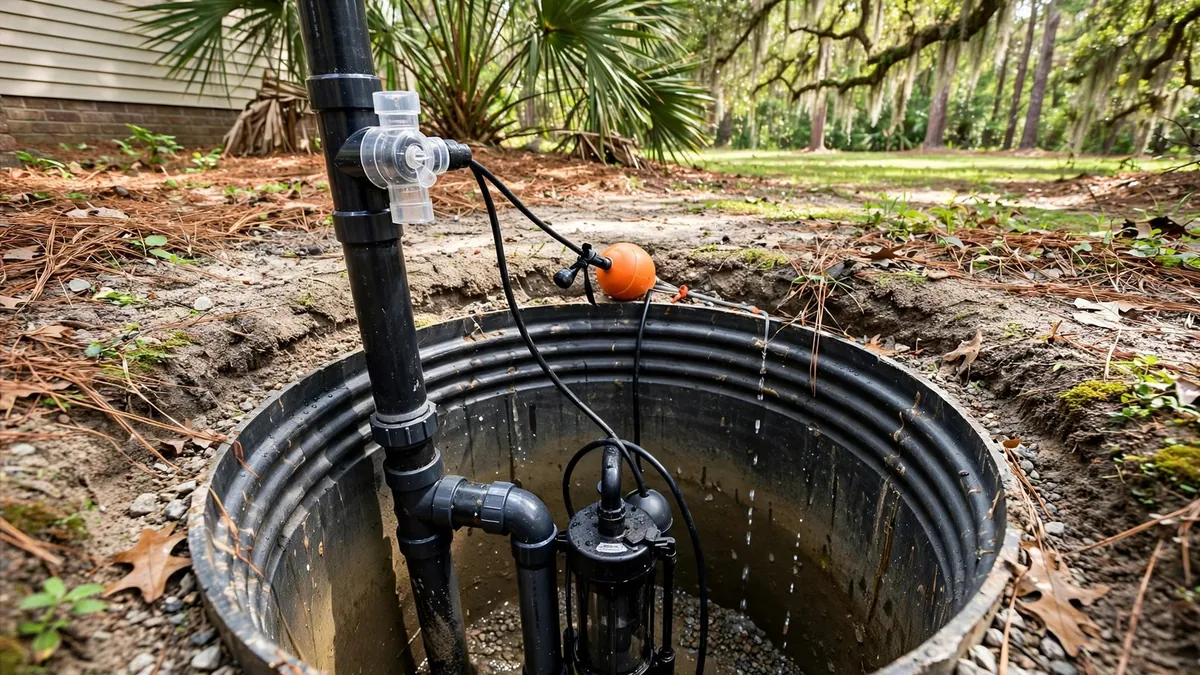
What to do before the storm: a five-minute pump check
Do this when the weather is dry, and the pump is far likelier to work when it counts.
- Pour in a bucket of water. The pump should start, empty the pit and shut off.
- Check the float. It should rise and fall freely. A stuck float is the commonest failure.
- Look at the discharge line. It should run well away from the foundation and not be crushed or frozen.
- Test the check valve. It stops water from falling back into the pit when the pump stops.
- Test the battery backup. A backup pump or battery that has not been checked in years may not run.
Pump types compared
Each pump type fits a different situation.
| Type | How it works | Best for |
|---|---|---|
| Submersible | Sits in the pit, quiet | Most homes with a pit |
| Pedestal | Motor above the pit | Shallow pits, easier to service |
| Battery backup | Second pump on its own battery | Outage-prone storm areas |
| Water-powered backup | Runs on municipal water pressure | Homes with no battery option |
Water rising in the pit?
Call now. If you can reach it safely, check that the pump has power and the float moves freely.
What the October 2015 flood taught the Midlands
During the October 2015 storm, a gauge on Gills Creek in Forest Acres recorded 10.64 inches of rain in four hours. At least four dams in the Gills Creek watershed failed, and the Columbia Canal breached. Saturated ground and power outages combined, which is the situation a battery backup is built for.
If your lot slopes toward Gills Creek, Rocky Branch or the Congaree floodplain, a backup is worth considering. Our location pages for Forest Acres and Cayce explain each area's flood pattern.
Installing a pump the right way
A good install starts with a sealed pit set below the floor, a pump sized to the water coming in, a check valve above the pump, and a discharge line that carries water away. The discharge should not feed back toward the house or into the sanitary sewer, which the local rules often forbid.
Where a house has no pit, a crawlspace or yard drain may need to be built first. See basement waterproofing for the drainage side of the same problem.
When the pump is not the problem
A pump that runs constantly may be handling a water line break, a high water table or a failed check valve. A pump that never runs may sit in a dry pit because the water found another path. A plumber looks at the whole system before replacing parts.
Winter and summer care for a sump system
In summer, thunderstorms make the pump run in bursts, so check it after the first big storm of the season. In winter, make sure the discharge line is not frozen or buried in leaves, because a blocked line backs water into the pit. Clean the pit of debris once a year and replace the battery on schedule.
Pumps near Gills Creek, Rocky Branch and the Congaree
Homes in Richland County near Gills Creek and Rocky Branch, and in Lexington County near the Congaree River, are where flood history makes pumps matter most. A battery backup covers the outages that storms bring. Your city or county sets where a discharge line may go, and local rules often forbid feeding it into the sanitary sewer that the South Carolina Department of Environmental Services regulates.
Sump pump repair: what each symptom means
Most sump pump repairs start with how the pump is behaving. Use this as a guide, then call if the fix is not obvious.
| What you see | Likely cause | Usual repair |
|---|---|---|
| Motor hums but no water moves | Jammed impeller or an airlocked pump | Clear the impeller, add a small relief hole, or replace the pump |
| Pump never turns on | No power, a tripped outlet, a dead switch or a stuck float | Reset the outlet, free the float, or replace the switch or pump |
| Pump runs nonstop | Float stuck up, failed check valve or a high water table | Reposition the float, replace the check valve, or fix the drainage |
| Pump cycles every few seconds | Check valve missing or leaking, or a pit that is too small | Fit a new check valve or resize the pit |
| Loud rattling or banging | Debris at the impeller or water hammer at the check valve | Clean the pit and replace the valve |
| Pit fills even though the pump runs | Pump undersized, or the discharge line is blocked or frozen | Clear or reroute the line, or upsize the pump |
Repair or replace: how to decide
A pump under five years old with a stuck float or a bad switch is usually a repair. One past eight to ten years with a rusty housing, a burned motor or a cracked base is usually a replacement.
A replacement is also the right moment to add a battery backup and a high-water alarm. Both cost far less than the flooring they protect.
Safe checks while the storm is still going
These steps keep you safe and give dispatch useful information.
- Stay out of standing water. Never reach into the pit while the pump is plugged in and water is high.
- Check the outlet. Look at the breaker and the outlet reset button first, since a tripped circuit is the simplest cause.
- Test the float from a dry spot. Stand on a dry surface and lift the float with a wooden handle. If the pump starts, the float was stuck.
- Slow the water if you can. Bail with a bucket to keep the level below the floor, and keep away from any electrics.
- Call and describe the sound. Humming, silence, rattling and nonstop running each point to a different repair.
Where sump pump repair calls cluster in the Midlands
Calls come from low or saturated ground. That means the Gills Creek side of Forest Acres, the Congaree banks in Cayce and West Columbia, the Saluda River side near Riverbanks Zoo and the bottomland around Hopkins in Lower Richland.
Houses in older neighborhoods such as Shandon, Earlewood and Elmwood Park more often have a crawlspace pit or a floor drain than a formal sump basin. Tell dispatch where the water collects and we plan the first visit around it.
Backup pumps and alarms: the repair most people skip
A battery backup only helps if the battery is alive. Batteries need replacing every few years, and many fail without warning because nobody tests them.
A high-water alarm costs little and gives you a warning before water reaches the floor. Ask for one at every pump repair.
What a sump pump repair visit includes
We start with the symptom and check power, the float, the pump, the check valve and the discharge line in that order. Most repairs end on one of those five parts.
Before any work you hear the price and the options. If the pit is cracked, undersized or filling from a leak, we explain that too, so the repair fixes the cause and not only the symptom.
What changes the price of sump pump work
Pump work is priced by what already exists and what has to be built.
Standard homeowners policies usually do not cover water that backs up through a sump. A water backup endorsement may. Ask your agent.
Want your real number? Call (844) 981-1691 and mention new pit or existing and pump size.
Drainage jobs near a sump pump
If water has already soaked a floor, water damage restoration covers the drying. A backed-up sewer line during storms points to backflow prevention and a backwater valve.
Sump pump questions
Many pumps last around ten years with normal use. Heavy use shortens that.
A stuck float, a failed check valve or a high water table can do it. A technician finds which.
If storms in your area cut power, yes. The pump is useless when the power is out.
Well away from the foundation, on ground that slopes away. Check local rules about where it may drain.
A jammed impeller or an airlocked pump is the usual cause. Unplug it before anyone touches the pit. A technician clears the impeller or replaces the pump.
The pump itself is usually a maintenance item that is not covered. Water that backs up through a sump may be covered only with an endorsement, so ask your agent.
Yes. Dispatch answers every hour of every day, and we start with power, the float and the check valve. Tell us if the water is still rising so we plan the first steps.